


An Unofficial Return to the Gray Zone
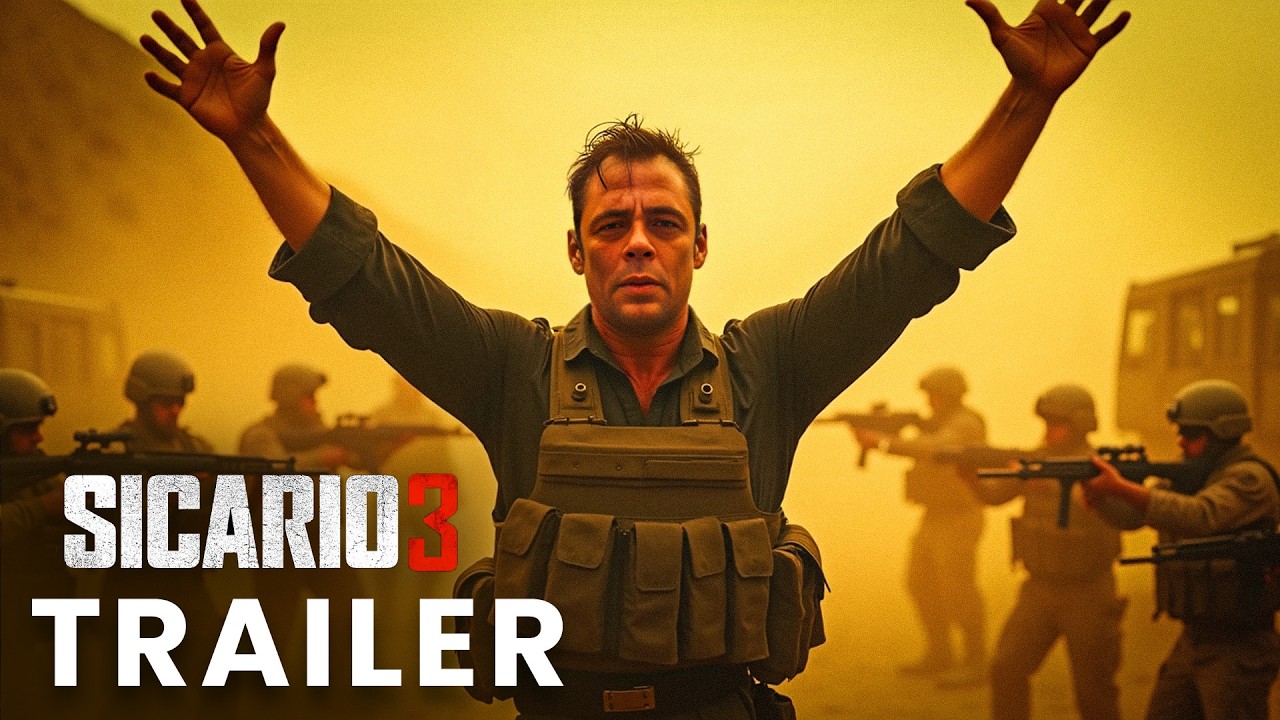
There are franchises that end with a period, and others that linger with an ellipsis. Sicario has always belonged to the latter. The recently released fan concept trailer for Sicario 3 (2026) doesn’t just imagine another sequel—it taps into the unresolved moral dread that made the first film so unsettling and the second so divisive. While not an official production, this concept trailer feels less like fan service and more like a cinematic thesis statement: the war has evolved, and so has the guilt.

From Border Warfare to Institutional Rot
The original Sicario films were never truly about cartels or borders. They were about systems—how they bend, break, and eventually consume the people operating within them. This imagined third chapter leans hard into that idea. The trailer reframes the conflict not as a territorial struggle, but as an abstract war against chaos itself. Underground organizations no longer seek land; they weaponize instability.

That shift feels thematically appropriate. In a world where power is increasingly decentralized, the notion of a clear enemy becomes almost quaint. The trailer suggests a story where the threat is internal, institutional, and moral—an enemy embedded deep within the very machinery meant to protect.

Benicio del Toro’s Alejandro: A Man Without an Exit
Benicio del Toro’s Alejandro Gillick has always been the franchise’s dark soul—a man shaped entirely by loss and purpose, with no room left for innocence. This concept trailer imagines his return as less of a choice and more of an inevitability. The so-called “gray zone” is not a location anymore; it’s his permanent state of being.
What makes this vision compelling is its restraint. Alejandro is not framed as a hero or even an anti-hero. He is a function. A tool pulled from storage because the system has once again decided that morality is a luxury it cannot afford.
Emily Blunt’s Absence as a Presence
Though Emily Blunt’s Kate Macer appears only briefly in the concept, her role looms large. The trailer positions her as a federal officer who has learned, perhaps too late, that the enemy isn’t across the border but embedded within her own side. This echoes the quiet tragedy of the first film: enlightenment without power is its own kind of punishment.
If realized, this dynamic could restore the moral counterweight that was largely absent in Sicario: Day of the Soldado. Kate’s perspective grounds the violence in consequence, reminding us that survival often comes at the cost of one’s conscience.
Tone, Atmosphere, and Visual Language
The trailer understands something crucial about the Sicario identity: atmosphere is narrative. Bleached deserts, suffocating shadows, and an ever-present sense of dread do more storytelling than exposition ever could. The editing is deliberate, the sound design ominous, and the silence—when it appears—feels accusatory.
Rather than escalating spectacle, this concept leans into inevitability. Violence is not thrilling here; it is procedural, almost bureaucratic. That choice aligns perfectly with the franchise’s bleak worldview.
What the Concept Trailer Gets Right
- Maintains the franchise’s moral ambiguity
- Re-centers the story on internal conflict rather than external enemies
- Respects the psychological weight of returning characters
- Uses atmosphere over action to build tension
A Battle of Conscience, Not Bodies
The most intriguing idea presented here is that Sicario 3 would not be a war between factions, but a war within individuals. Every decision carries irreversible consequences, not because of what explodes, but because of what erodes. Trust. Law. Identity.
This fan-made vision understands that the true horror of Sicario has never been death—it’s complicity. If an official sequel ever materializes, it would do well to study this concept closely. It remembers what the franchise is really about.
Final Verdict
As a piece of speculative filmmaking, the Sicario 3 fan concept trailer is remarkably thoughtful. It doesn’t chase nostalgia or cheap escalation. Instead, it asks the hardest question the series has always posed: what happens when the system demands your soul, and you’ve already given it once?
If this is the direction a real Sicario 3 were to take, it wouldn’t just continue the story—it would complete the sentence the first film started.