




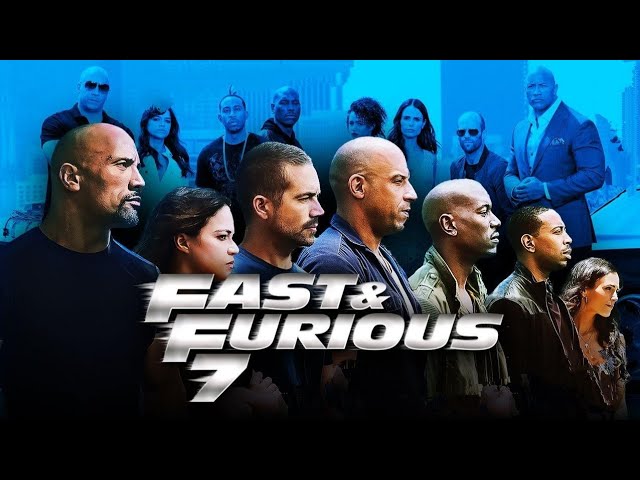
A Franchise Forced to Slow Down
When Furious 7 arrived in theaters, it carried a weight no previous entry in the Fast and Furious saga had ever known. What was conceived as another high-octane installment became, through tragic circumstance, a film shaped by loss. The sudden passing of Paul Walker in 2013 did not merely interrupt production; it altered the emotional DNA of the movie itself.

This is a franchise built on speed, momentum, and excess. Yet here, it was compelled to pause, to reflect, and to acknowledge that the people behind the spectacle mattered as much as the spectacle itself. In that pause, Furious 7 found an unexpected soul.

Paul Walker: More Than Brian O’Conner
Paul Walker’s presence in the series had always been deceptively simple. As Brian O’Conner, he was the calm center in a universe of roaring engines and loud bravado. Walker played him not as a cartoon hero, but as a decent man navigating a chaotic world. That decency extended beyond the screen.

Walker famously shunned celebrity excess, choosing a quieter life of philanthropy and private service. His legacy was not constructed through scandal or spectacle, but through consistency and loyalty. When he died, the loss felt personal to audiences because the sincerity he projected was unmistakably real.
A Production Guided by Respect
The way Furious 7 was completed speaks volumes about the character of its creators. Rather than hastily rewriting the film or digitally erasing Walker’s absence, the production chose a path of reverence. His brothers stepped in to help complete unfinished scenes. The narrative was adjusted, not to replace him, but to let him go.
This decision transformed the movie into something rare for a blockbuster of this scale: a collaborative act of mourning. Vin Diesel’s public acknowledgment of Walker as a brother was not marketing language; it was the emotional truth that guided the film’s final shape.
Action as Catharsis
Make no mistake, Furious 7 delivers the franchise’s expected thrills. Cars parachute from planes. Skyscrapers become launchpads. The laws of physics are bent, if not outright ignored. Director James Wan stages these moments with clarity and confidence, ensuring that spectacle remains exhilarating rather than exhausting.
Yet the action feels different this time. There is a sense that the explosions and chases are no longer the point, but the language through which the characters express loyalty and grief. The film understands that action, like ritual, can be a way of processing pain.
Standout Elements
- A confident shift in tone that balances spectacle with sincerity
- Action sequences staged with emotional context rather than empty excess
- A supporting cast that plays not as caricatures, but as a chosen family
The Meaning of Family
The Fast and Furious series has long preached the gospel of family, sometimes to the point of parody. In Furious 7, that word finally earns its weight. Family here is not a slogan, but a bond tested by loss and sustained by remembrance.
The characters are no longer chasing freedom or fortune. They are protecting memories. They are honoring someone who mattered. In doing so, the film invites the audience to reflect on their own connections, on the people who leave marks that cannot be erased by time.
The Final Drive
The closing moments of Furious 7 are among the most affecting in modern blockbuster cinema. A quiet road. Two cars side by side. One path diverging from the other. It is a farewell expressed without dialogue, trusting images and music to carry what words cannot.
Audiences around the world wept not because the scene demanded it, but because it earned it. This was not grief manufactured for dramatic effect. It was shared, communal, and deeply human.
Final Verdict
Furious 7 may wear the skin of an action spectacle, but at its core it is a eulogy. It honors Paul Walker not by freezing him in myth, but by allowing his character to move on with grace. In doing so, it reminds us that even the loudest franchises are, ultimately, made of people.
This is not the best Fast and Furious film because of its stunts. It is the most meaningful because it understands when to let go. And that understanding is what makes the final ride unforgettable.